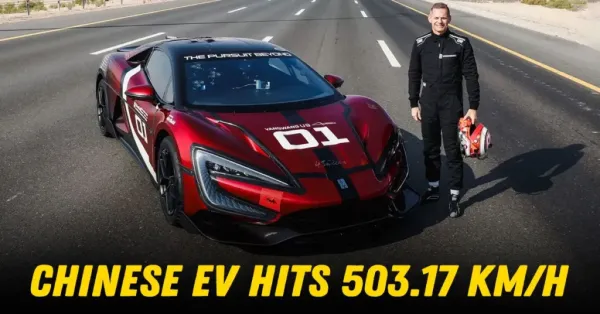
Chinese Electric Hypercar Hits 503.17 Km/h, Sets Two Guinness Records
BYD’s Yangwang U9 Xtreme has become the first production car to cross 500km/h in a verified single-direction speed run. The electric hypercar reached 503.17km/h on a closed highway in Abu Dhabi on November 1, 2026, earning two Guinness World Records. The achievement was verified by the FIA, with German racing driver Marc Basseng behind the wheel.
The two records are for the highest speed reached by a production car and by an electric production car in a single-direction run. The qualification matters. It is a verified peak speed, not the average of two runs in opposite directions used in some traditional production-car record attempts. Calling the U9 Xtreme the outright fastest car under every possible record rule would therefore be inaccurate.
The attempt took place on Sheikh Khalifa Bin Zayed International Road, also known as the E11, in Abu Dhabi’s Al Dhafra region. Authorities closed around 10km of highway, including a straight section approximately seven kilometres long. That gave the driver enough room to accelerate to extreme speed and then slow down safely.
The preparation was more demanding than it might appear from a video of a car passing at high speed. The road was swept, and the team checked the surface for small pieces of wire and other debris that could damage a tyre. At more than 500km/h, tyre stability, road surface and aerodynamic loads become critical.
Two initial runs on October 31 reached around 490km/h. Engineers then adjusted the rear wing, suspension settings and tyre pressures before the next day’s attempts. On November 1, the second run produced 503.17km/h. Guinness says the measurement was independently checked with a calibrated VBOX system, with the FIA reviewing the evidence.
The record did not come from an entirely new machine. The U9 Xtreme had already achieved 496.22km/h at the ATP Papenburg test facility in Germany in September 2025, also driven by Basseng. The Abu Dhabi run improved that figure by 6.95km/h and crossed the 500km/h barrier that the earlier attempt had narrowly missed.
BYD’s progress has been rapid. The standard Yangwang U9 recorded 309km/h during testing in China in January 2024 and 391.94km/h in Germany later that year. The uprated Xtreme reached 472.41km/h in August 2025, before raising the figure to 496.22km/h the following month.
The U9 Xtreme has also completed a Nürburgring Nordschleife lap in 6 minutes 59.157 seconds, a record for production electric vehicles. Top speed and lap time measure different qualities: a car needs maximum power and low drag for the former, but handling, braking and sustained cooling are equally important for the latter.
The Yangwang U9 Xtreme uses four electric motors, one driving each wheel, with combined output quoted at 3,019PS. That is more than twice the power of the regular U9, which produces around 1,287PS. Its electric architecture operates at 1,200 volts, allowing the motors and battery system to deliver extremely high power during short bursts.
Individual wheel control also allows precise distribution of torque. At these speeds, keeping the vehicle stable is as important as making it accelerate. The U9 Xtreme uses active suspension, specialised high-speed tyres developed with Giti and cooling systems designed to manage the heat produced by its motors, battery and power electronics.
This is not a regular U9 with a software upgrade. The Xtreme is a specialised limited-production derivative with major changes to the motors, electrical system, suspension, tyres and thermal management. BYD plans to produce only 30 examples worldwide. It has not announced an India launch or an official local price.
In a two-way record attempt, the car normally travels along the same course in both directions and the results are averaged. That reduces the effect of a tailwind, headwind or slight change in road gradient. A single-direction result uses the fastest verified speed in one direction and is therefore a separate Guinness category.
The U9 Xtreme’s 503.17km/h was verified, but it should not be compared without qualification to records established under a different method. Nor does a top-speed achievement establish how quickly the car accelerates in everyday conditions, how far it will travel on one charge or how easy it is to drive on public roads.
Contact to : xlf550402@gmail.com
Copyright © boyuanhulian 2020 - 2023. All Right Reserved.