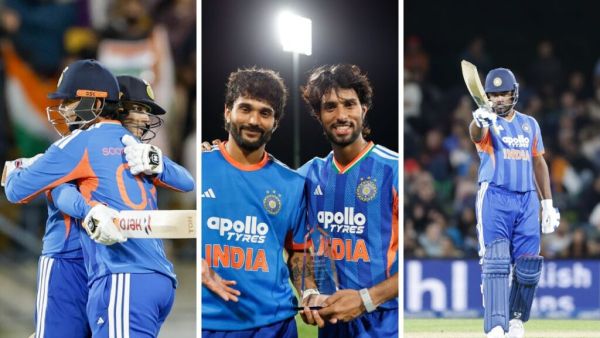
India vs New Zealand T20I Series: The real strength of a team is not just in winning matches continuously, but in winning in a different way every time. The Indian team did the same in the T20 series against New Zealand. Three matches, three different situations and three different ways to win… somewhere Sanju Samson and Abhishek Sharma The stormy start changed the course of the match, somewhere Tilak Verma took charge in difficult times, and somewhere Abhishek Sharma batted in such a way that chasing the target became a mere formality.
There were some similarities between these three victories. Fast runs in the powerplay, useful cameo by Naman Dheer and confidence of victory even in difficult situations… but the real story of these matches goes far beyond these similarities. The Indian team showed that its batting does not depend only on the top order. If needed, middle order and lower order batsmen can also change the course of the match. This flexibility is the biggest identity of a strong T20 team.
Sanju laid the foundation, Naman Dheer gave the finishing touch
The conditions in New Zealand were considered challenging for the Indian batsmen. It was expected that the swing of the new ball and later the helpful pitch of the spinners would curb the pace of India’s aggressive batsmen, but in the first match, the Indian opening batsmen proved these apprehensions wrong.
New Zealand had made a big score of 225 runs. The ball was swinging in the initial overs, but Sanju Samson and Abhishek Sharma chose to counter-attack instead of coming under pressure. Both added 93 runs in just 5.4 overs. Sanju completed his half-century in 23 balls. The specialty of his batting was that instead of taking unnecessary risks, he played shots according to the direction of the ball and his strength. Against the fast bowlers, he scored runs from cover to midwicket, while attacking the spinners towards midwicket.
The importance of this fast start was understood when the pitch started slowing down and the spinners started restricting the Indian batsmen. When Sanju was bowled by Mitchell Santner after scoring 67 runs, the Indian innings appeared to be faltering for some time. At such a time, Shreyas Iyer took the responsibility and Naman Dheer With aggressive batting, the match again turned towards India.
Dheer scored 42 runs in just 15 balls. This was not just an innings of scoring fast runs, but also a demonstration of the ability to finish the match under pressure. Players playing in competitions like IPL have a habit of taking fast decisions in difficult situations. Using this experience, Dhir played an important role in taking India to the target.
When Tilak Verma changed the story after five wickets fell
The story of the second match was completely different from the first match. After the start of the Indian team here, the competition seemed to be going out of its hands. Mitchell Santner’s spin on a slow pitch made Indian batting difficult. India’s situation became very critical due to the fall of two wickets in one over. The team had lost five wickets and needed 110 runs in 54 balls.
This target was not impossible in T20 cricket, but the pitch and falling wickets had increased the challenge. At such a time, Tilak Verma decided to take over the innings. It has not always been a natural role for this Hyderabad batsman to finish the match in the lower order, but he has gradually made this responsibility his strength.
Tilak kept the risks low in the beginning. He could score only nine runs on the first 10 balls, but as the match reached the decisive turn, his batting style kept changing. He scored 42 runs in the next 16 balls. Under pressure, his shots showed speed and control. Naman Dheer and Nitish Kumar Reddy also supported him well. Together they added 57 runs in 30 balls. This contribution was very important on a slow pitch, because it was not easy to hit big shots on every ball. India won the match on the penultimate ball.
This victory gave a big indication about the batting of the Indian team. The strength of the team is not limited to just the top three batsmen. Even when the opening batsmen fail or the pressure on the middle order increases, the lower order batsmen still have the ability to win the match. Tilak’s innings became an example of this confidence.
When Abhishek Sharma created a ruckus
Another color of Indian batting was seen in the third match. The competition to open the innings is intense and many young batsmen are waiting for their chance. This time Vaibhav Suryavanshi got a chance. He showed his aggressive ability by scoring 44 runs on 19 balls… but the biggest story of the match was the batting of his partner Abhishek Sharma.
In the very first over, both the batsmen together scored 26 runs. This was equal to the record of jointly scoring the most runs in the opening over of an innings. After this Abhishek took command of the innings. There was so much pace in his batting that by the end of the powerplay, India had crossed more than half of the target and the required run rate had fallen below six.
Abhishek completed his century in 35 balls. This innings will not only be remembered for its pace figures, but also because it did not even give time to the opposition bowlers to change their strategy. When a batsman scores runs at such a fast pace, the bowlers have fewer and fewer defensive options. Abhishek continuously increased this pressure and tilted the match in favor of India.
This innings has also ended the ongoing debate regarding his place. Even though the opening competition between players like Sanju Samson and Vaibhav Suryavanshi may continue, Abhishek showed how quickly he can change the course of the match with his aggressive style.
What did the three wins reveal?
The most important thing about these three matches against New Zealand was not only that India achieved the targets. The real thing was that every time the team changed its method according to different circumstances. A fast start and aggressive finish became decisive in the first match. In the second, Tilak Verma and the lower order won under difficult conditions. Abhishek Sharma’s explosive batting in the third made chasing the target very easy.
Naman Dheer’s contribution also emerged as an important link in these matches. His useful innings showed that the Indian team does not need to depend only on big names. At the same time, Tilak’s innings strengthened the belief that the middle order can take responsibility in times of pressure.
In T20 cricket, the same strategy is not successful in every match. The style of batting has to be changed according to the demands of the pitch, bowlers and target. The Indian team showed the same flexibility against New Zealand. The destination was winning every time, but the path to reach there was different. This is the biggest story of three victories.
Contact to : xlf550402@gmail.com
Copyright © boyuanhulian 2020 - 2023. All Right Reserved.