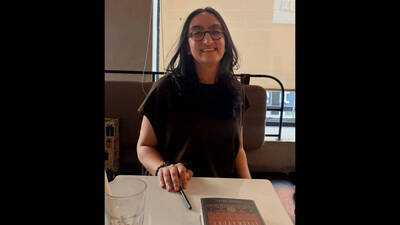
Three years ago, Onaiza Drabu , a writer and researcher from Srinagar who is also an avid reader, promised herself to read almost nothing but Kashmiri literature . From that vow came 'The Big Book of Kashmiri Literature', an anthology she compiled and edited, published in Aug this year.
The volume, published by Penguin Random House, spans seven hundred years of life in Kashmir in the form of folk songs and lullabies, Sufi poetry, short stories, radio plays and contemporary writing in English translation. In an interaction with Toibah Kirmani, Drabu spoke about her inspiration and how she hopes the work will help change how Kashmiri literature is understood.
What is the book all about?
It really is a journey through Kashmir’s history told through its literature, where the reader encounters scholars, saints, experimental dramatists and unlettered poets, from 14th century to the present.
Kashmir has a thriving oral tradition, a literary culture that borrowed from the East and a print culture that engaged with the West, and it all comes together in this volume.
I organised the pieces around themes such as finding home, a chronicle of social history and the awakening of consciousness, devotion and love, descriptions of the mundane and everyday, and the folk and liturgical poetry and songs that accompany our lives.
I also wanted the pieces to speak to one another so that together they offer a picture of Kashmir as we know it.
The first section, Jaai Katyu Chai?, or “Where Is Your Place?”, is about home, land, belonging and exile, and the many ways writers imagine their place in the world. In this section, a poem by Moti Lal Saqi about an abandoned house is placed alongside a poem by the younger poet Nighat Sahiba, who grew up in the 1990s and saw the abandoned homes of Kashmiri Pandits, for instance.
How did you get the idea that you wanted to do such a book?
The book came about as an answer to a wish said out loud. Sat-e-hasan, as they say in Kashmiri, is a time of day when all that is said comes true, and I remember wishing I had a year to just sit, read and understand Kashmiri poetry .
Since a lot of Kashmiri poetry is mystical, I had this idea of travelling to the shrines of Sufi poet-saints across the valley, and as I began putting together a reading list for myself, I got an email from Moutushi, an editor at Penguin, saying that they would love to chat about a compilation of Kashmiri literature and that I’d been referred and if I’d be up to the task.Of course, I said yes, and very gladly so.
Since then, it has been a journey of gathering texts, finding families, making connections, looking for recitations, trawling through libraries for old journals, and obsessing over book covers and typography, and now, three years later, here we are. I don't think I can read another Kashmiri text for a while.
Did you come across any writing that surprised you?
I found some pieces that I really enjoyed and did not expect to find. One that surprised me was Adam Hawa Iblees by Ali Mohammad Lone, because it was different from the kinds of writing and themes I thought were natural to the language.
It was first written as an absurdist stage play and later adapted for radio. It brings in ideas from existentialism and was influenced by the left-wing movements of the mid-20th century, but what I really enjoyed was how unexpected the dialogue could be. At one point, characters even break the fourth wall and speak to the audience directly, acknowledging that they are in the play. The translator first introduced me to it through his excellent translation, and I then went looking for the original, which I enjoyed even more.
What were your early experiences with Kashmiri oral storytelling traditions ?
Grandmothers are often the main storytellers, and so was mine, and both my books have something to do with her. My first book, Legend of Himal Nagrai: Greatest Kashmiri Folktales, was on Kashmiri folklore; I collected and retold stories that I had loved as a child, and in the process I was introduced to translation as a practice.
From there, I started reading Kashmiri fiction and translating short stories as I read them, and I have also always enjoyed Kashmiri poetry and verse as a way of connecting with my grandmother. For her, that musical world of Kashmiri verse is integral and embedded in life.
What role have women played in Kashmiri literature and oral traditions?
Women have been both authors and carriers of this literature. They have been writing, singing and creating literature for a very long time. ‘Anonymous’, as they say, was often a woman, and there are many anonymous writings in the book.
Publishing has often been dominated by men, and women may not always have had the same stage as their male counterparts, but they have continued to write, and there are several examples in the book where women write about their own experiences.
One is Naseem Shafaie's Samandar te Be (The Ocean and I), which can be read as a poem about patriarchy, although, of course, the poem is open to interpretation.
What do you hope will change about the way Kashmiri literature is read and understood?
One thing that the selection in the book hopefully does is it makes the case for the idea that literature is everywhere and omnipresent. It's sites can be homes and shrines just as much as they can be books and libraries. Oral literature is as much a part of our corpus of classics, and much of the literature in this collection comes from oral traditions.
And if you look at Kashmiri literature translated into English and published outside Kashmir, it is mostly mystical poetry, romantic poetry and a handful of short stories, but there is so much more. I wish the book changes the view that a lot else has happened and continues to happen.
I also hope readers get a sense of the texture and everyday rhythms of life in Kashmir and how Kashmir also has ways of thinking, remembering and understanding the world above and beyond politics which often reaches the newsrooms and we hear the loudest.
What are you reading when you aren't reading for work?
For the last three years, I basically put a ban on myself and exclusively read Kashmiri literature or books. Since I can now finally read again, I've enjoyed Ann Patchett's new book Whistler. I actually listened to that as an audiobook because, as a new mother, I find it easier to keep my focus.
I also listened to Arundhati Roy's Mother Mary and thoroughly enjoyed it. I love Maggie Nelson's prose, so I read her latest, Pathemata, and returned to The Argonauts. And I've finally started reading Shabir Ahmad Mir's The Last Knot.
Contact to : xlf550402@gmail.com
Copyright © boyuanhulian 2020 - 2023. All Right Reserved.