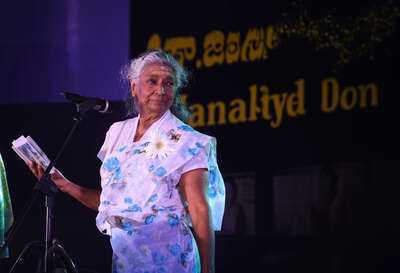
For over six decades, the voice of S Janaki was more than music. It was the sound of first love, heartbreak, devotion, motherhood, longing and hope. On July 11, Indian music bid farewell to one of its greatest legends, bringing the curtain down on a golden era of playback singing .
Affectionately called Janaki Amma and revered as the Nightingale of South India, she left behind a body of work that transcended generations, languages and borders. Her songs did not merely accompany cinema—they became the emotional heartbeat of millions of lives.
Without formal classical training, she created one of the most extraordinary careers in Indian music, recording more than 48,000 songs in over 20 languages. From timeless melodies composed by Ilaiyaraaja and M S Baburaj to modern classics with A R Rahman, Janaki continually reinvented herself while remaining unmistakably her own.
A voice that could become anyone
Few singers possessed Janaki's astonishing gift for vocal transformation. She could sound like a mischievous child, a shy teenager, a grieving mother or a playful village girl — all within the span of a recording session. It was this unmatched emotional intelligence that earned her the title Queen of Expression.
Perhaps no song demonstrated this better than
Senthoora Poove from
16 Vayathinile. Nearly 40 years old when she recorded it, Janaki effortlessly captured the innocence and vulnerability of a 16-year-old heroine portrayed by Sridevi. The performance won her the first of her four National Film Awards .
A love story that changed Indian music
Behind every great artiste stood one unwavering believer. Before the world discovered Janaki, a young V Ramaprasad, affectionately known as Ramu, heard her sing on a small stage and became convinced she was destined for greatness. Determined to give her an opportunity, he persuaded his father to write to AVM Studios requesting an audition.
The two married in 1959. For the next four decades, Ramu accompanied Janaki to nearly every recording session. Reflecting on their extraordinary partnership, she once said: "He was mad about my music and would never leave me alone even during my recording sessions... He was there with me, he is there with me, and he will be there with me in my thoughts." It remains one of Indian music's most enduring love stories.
The competition that changed her life
Janaki's remarkable journey began not in a conservatory but through instinct. Having learnt music simply by listening to a local nadaswaram player during childhood, she entered the All India Radio National Light Music Competition in 1956 despite having almost no formal training.
She finished second in the country and received the honour from the President of India. That recognition convinced her family to support her musical ambitions, eventually leading her to Madras (Chennai) — the city where her legendary playback career began.
The singer who belonged to every language
Though Telugu was her mother tongue, Janaki became one of India's greatest linguistic chameleons. She recorded songs in Tamil, Telugu, Kannada, Malayalam, Hindi, Bengali, Odia, Marathi, Sanskrit, Tulu, Sinhala, Japanese, German, French and English, among others.
Her Malayalam diction was so flawless that generations of listeners assumed she was a native speaker. She remains the only non-Malayali singer to win the Kerala State Film Award for Best Playback Singer 11 times.
Hindi composers, too, marvelled at how effortlessly she erased every trace of a regional accent in songs like
Yaar Bina Chain Kahan Re.
The impossible songs
Musicians often tested Janaki with compositions others hesitated to attempt.
One of the finest examples remains
Shiva Shiva Ennada Naagege from the Kannada film
Hemavathi (1977), an extraordinarily demanding composition in the Todi raga. Without formal classical education, Janaki mastered its intricate movements and delivered a recording that continues to be regarded as a benchmark of playback singing.
The golden trio
For millions of South Indians, the sound of romance belonged to three people.
Composer Ilaiyaraaja, singer S P Balasubrahmanyam and S Janaki created a musical partnership that defined an era.
Their recordings weren't merely sung — they were performed. Every glance across the microphone, every shared smile and every perfectly timed breath gave their songs an emotional realism that continues to resonate decades later.
Grace with conviction
Janaki's humility was matched only by her integrity. In 2013, when she was announced as a recipient of the Padma Bhushan, she politely declined the honour, saying it had come too late in her career. More importantly, she hoped the decision would draw attention to what she believed was the historical under-recognition of South Indian artistes at the national level. It was not about rejecting an award; it was about standing by a principle.
The last song: Choosing the perfect goodbye
In an industry where many artistes continue until circumstances force them to stop, Janaki chose a different path. In 2016, she quietly announced her retirement from playback singing, explaining that she wished to step away while her voice still retained its beauty rather than allow age to diminish it.
Her final recorded song was the Malayalam lullaby
Amma Poovinum… from
10 Kalpanakal.
The
last concert: Where it all began
On October 28, 2017, she gave her farewell concert at Manasagangotri in Mysuru, returning to the very city where she had performed her first public concert 60 years earlier alongside P B Sreenivas. More than 20,000 fans gathered to witness a farewell that felt less like an ending and more like a celebration of a life devoted to music.
Contact to : xlf550402@gmail.com
Copyright © boyuanhulian 2020 - 2023. All Right Reserved.