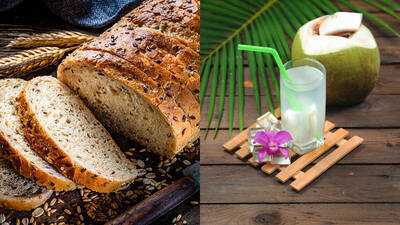
As customers, we often fall prey to organic and natural products, as they often claim to be preservative-free. When it comes to a reality check, many brands fail, which is an alarming sign for us as consumers to take extra care before buying such foods and make sure to read the ingredients. In a recent incident, the Central Consumer Protection Authority (CCPA) imposed a penalty of Rs 1 lakh each on Storia Foods and Beverages Private Limited and Mrs. Bectors Food Specialities Limited, the maker of English Oven bread, for using the expression "100%" in their products, which were actually laden with preservatives. Scroll down to read the details.
According to Economic Times report, the CCPA took suo motu cognizance of Storia Foods' advertisements claiming "100% Tender Coconut Water" as well as juices described as 100 per cent pomegranate, mixed fruit, mango and guava chilli. During the investigation, it was found that the ingredients used for the product included water and coconut water concentrate (9.6%) reconstituted to be "equivalent" to 100% coconut water. The word "reconstituted" appeared only in fine print in the ingredient panel not prominently disclosed alongside the headline claim. The product also contained the Class II preservative INS 202, which the CCPA said made a concurrent claim of "100% Natural" wholly untenable.
The CCPA team also examined English Oven advertisements, which claimed "100% Atta Bread," "100% Whole Wheat Bread," "Naturally rich in whole grains with 100% whole-wheat flour," and slogans like "The taste of 100% Wholesome Happiness." During the investigation, it was found that the products contained only 87 per cent whole wheat flour, a figure the CCPA found irreconcilable with the "100%" claim. The authority also flagged the simultaneous use of "100% Whole Wheat Bread" and "Zero Maida" on packaging, noting that the combination created a cumulative and false impression that the product was composed entirely of whole wheat flour.
During the proceedings, Mrs Bectors acknowledged that the dual representation appeared "redundant in nature." Mrs Bectors argued that "100% Atta" was intended only to convey that wheat flour was the sole grain source used, not a claim about the total composition.
According to the report, the CCPA rejected the defence and said that if a representation is capable of misleading consumers, the advertiser's intent is irrelevant. The CCPA reiterated that all claims relating to composition, quality, nutrition or health benefits must be truthful, verifiable and non-deceptive, and said it would continue enforcement action wherever consumers are misled about the nature or composition of products.
The authority, headed by Chief Commissioner Nidhi Khare and Commissioner Anupam Mishra, has directed both companies to immediately withdraw the claims from their product packaging, websites, and all digital platforms, under the Consumer Protection Act, 2019, and the Guidelines for Prevention of Misleading Advertisements and Endorsements, 2022.
Contact to : xlf550402@gmail.com
Copyright © boyuanhulian 2020 - 2023. All Right Reserved.