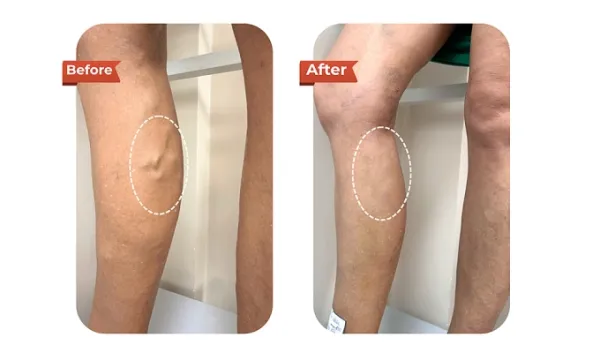
Adam Brian, 63, said years of international travel following his retirement from a job that involved prolonged standing and sitting had increasingly affected his mobility because of symptoms associated with venous insufficiency.
“I love traveling and exploring different countries, landscapes and cuisines, but my condition gradually became a major obstacle,” he said. “Because travel schedules were always tight, I could never commit to long treatment timelines, so I lived with the problem for nearly 10 years.”
Brian later sought treatment at Dr.Vein clinic in Ho Chi Minh City.
The patient’s right leg before (L) and after (R) treatment. Photo courtesy of Dr.Vein |
According to the clinic, Brian had previously consulted doctors overseas several years earlier but did not proceed with treatment because of language barriers, travel constraints and concerns about treatment methods.
At Dr.Vein, he underwent a clinical examination and Doppler ultrasound performed by Dr. Le Kim Cao, a Specialist Level II physician.
The scan identified reflux in the great saphenous vein in the right calf, with reflux duration exceeding two seconds. Multiple superficial veins around both ankles were also visibly dilated.
Doctors diagnosed him with lower-extremity venous insufficiency classified as CEAP clinical class C1.
Medical imaging at Dr.Vein showed venous reflux in the patient’s lower leg.
According to the clinic, venous reflux occurs when valves inside veins no longer function properly, causing blood to flow backward and increasing pressure in the lower extremities. Common symptoms include heaviness, swelling, burning sensations and fatigue.
Following the diagnosis, doctors recommended a minimally invasive treatment plan combining ultrasound-guided foam sclerotherapy and superficial vein sclerotherapy.
The procedure, which lasted approximately 15 minutes, was performed without hospitalization or significant recovery time, allowing the patient to resume normal activities shortly afterward.
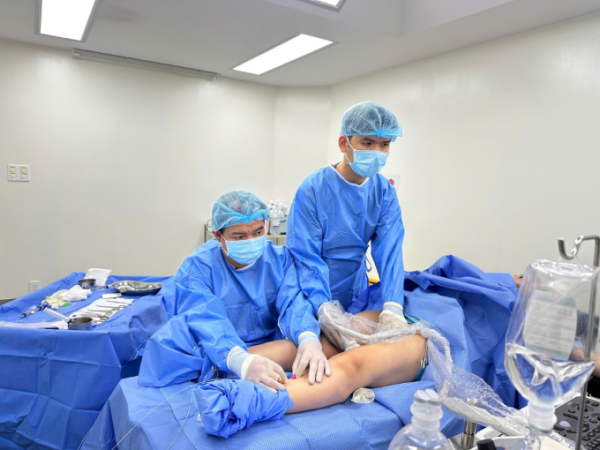 |
Doctors perform treatment at Dr.Vein. Photo courtesy of Dr.Vein |
According to the clinic, ultrasound-guided foam sclerotherapy involves injecting a sclerosant solution into affected veins, causing the vein walls to collapse and preventing abnormal blood flow.
Brian said the detailed consultation process and real-time ultrasound imaging helped him feel more confident about undergoing treatment.
“The doctor’s explanations and understanding of international patients helped remove many of my concerns,” he said. “I was surprised to find a medical facility in Vietnam with standards comparable to major hospitals abroad.”
The patient was able to resume normal activities shortly after treatment.
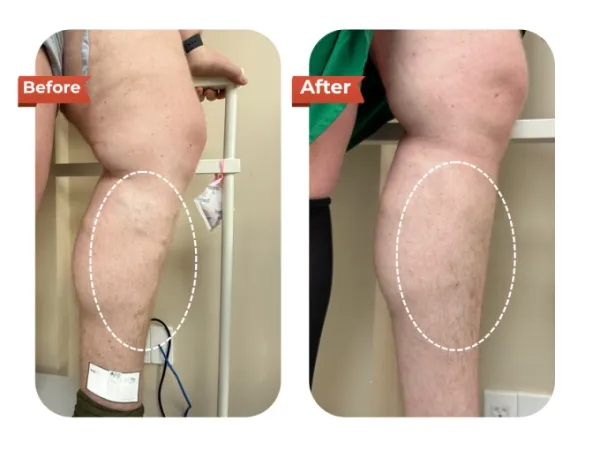 |
The patient’s left leg before (L) and after (R) treatment. Photo courtesy of Dr.Vein |
Following treatment, physicians advised maintaining healthy habits to help reduce the risk of recurrence, including wearing compression stockings during prolonged standing or sitting, avoiding positions that increase pressure on the legs, exercising regularly and maintaining a balanced diet.
Doctors also recommended that people experiencing persistent symptoms such as leg heaviness, fatigue or burning sensations in the feet seek medical evaluation early rather than dismissing the symptoms as ordinary tiredness.
According to the clinic, early diagnosis and timely treatment may help prevent disease progression and improve long-term quality of life.
Contact to : xlf550402@gmail.com
Copyright © boyuanhulian 2020 - 2023. All Right Reserved.