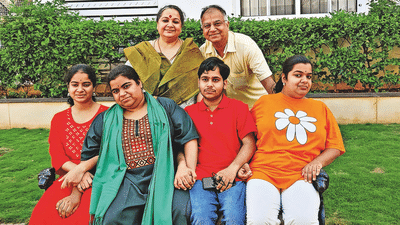
Raising a kid is tough. Raising four is tougher. Sangeetha Chakrapani has brought up quadruplets, two of them with autism, bravely facing unique challenges at every step. She is now using her experience and learnings to create a better world for neurodivergent kids. The Mumbai mom, whose memoir ‘Whatever It Takes’ was released recently, spoke to
Neha Bhayana about how acceptance can help families with autism find their ‘happily ever after’
When doctors figured you were expecting quadruplets, they advised you to go for foetal reduction and keep only the two healthier babies, but you refused. Your kids are 22 now. How has this journey changed you?
I don’t like surprises anymore. I watch the same movies and read the same books. I surround myself with predictable routines, but life continues to present me with unpredictable things. The quadruplets were not a surprise that I could not handle, as I have always wanted a big family. My grandmother had ten children, though not simultaneously. Many women have had babies one after the other, year after year. It’s not a big deal. That my children had autism was the surprise I could not accept, and I knew it would be a tough journey. But once I started walking that path, new vistas of hope and opportunity became visible to me. I could see that autism and living happily can go side by side. Often, I have felt alone and overwhelmed. Not that people did not ask how I am, but I felt no one understood me. It was a journey towards self-acceptance, accepting my children and respecting their unique identities. My children grew up, and I grew up all over again with them.
In 2015, you started a non-profit organisation ( Together Foundation ) to impart skill training to young adults with autism. Do you think govt and non-govt organisations ought to explore more employment avenues to tap the potential of people with autism?
Years ago, I had knocked at the doors of a leading hypermarket, carrying a box of our freshly-baked cookies. They would not even open the box of cookies, much less taste them. “Who are you?”, “What’s your credibility?” they asked. That day, I vowed to myself that never again would anyone ask my special adults or me these questions. In a year, our bakery got the FSSAI certification and Together Foundation has never looked back. With an increase in the number of children diagnosed with autism and growing awareness about the potential of people who have autism, the future lies in building autism-smart work environments. Businesses must zero in on autism-friendly offices and create sheltered and supportive environments that will also create manifold job opportunities for neurotypical people.
The Supreme Court recently banned stem cell therapy for autism as there is no scientific evidence of its efficacy, putting an end to years of false hope. Do you think the focus needs to shift from curing autism to supporting it?
This is a painful question for most parents to answer. Most of us have a tiny flickering hope that autism is treatable: a hope that, at first, burns very brightly when the child is diagnosed and grows duller and duller as time passes. Parents try multiple avenues of treatment for their child: homoeopathy, ayurveda, acupressure, acupuncture, hyperbaric oxygen therapy, chelation, and craniosacral treatment. There is no denying the fact that, until now, there is no single known and proven cure for autism. So, what must we bear in mind? First, do not try any treatment that has the potential to harm or negatively impact the child. Save your resources. Autism is an expensive disability to have, and parents would do well to put their resources to better use. Therapy is slow and the centres where one can get free or subsidised consultations are few and far between. However, slowly but surely, we see our children responding, learning and growing. There is no better alternative.
‘What happens after us?’ is the biggest worry for parents with special needs kids. Several parents (including you) are building private residential facilities for people with autism. While these will secure the future of kids whose parents have the funds and foresight, there is little hope for poor families. Your thoughts?
Disability is a luxury that many cannot afford. It raises its head in the most poverty-stricken and underprivileged areas. Right from the time of diagnosis in early childhood to assisted living in adulthood, opportunities for the underprivileged are limited. People in the lower economic strata are not even aware of the resources and schemes that are available. Most residential communities charge a monthly fee of at least Rs 60,000 for individuals with special needs. Our residential facility, The Together Community at Hosur in Tamil Nadu , charges Rs 1 lakh per month for the individual and their parents. Our second goal — and a bigger one — is to work on a low-cost model of residential community for people with special needs, supported by CSR initiatives.
Awareness regarding autism has increased over the past decade, but mainstream schools are still reluctant to admit children with special needs. Are special schools the only solution?
Mainstream schools are reluctant because they are not equipped with the resources and infrastructure. In order to provide inclusive education, the regular schools must have sufficient teachers who have the knowhow to contribute to an inclusive classroom; professional expertise to ensure the neurodivergent programme is holistic; additional space for taking extra classes; an outdoor programme for ensuring physical exercise and engagement breaks; assisting staff to help with restless or hyperactive children; and tailored programmes to promote meaningful social inclusion. Without these resources, many schools ask parents to provide a shadow teacher for their child, whose salaries have shot up due to high demand. Inclusive education will need to be funded in govt schools and other schools in lower economic areas. Parents who belong to middle-income families cannot afford it either. So, in despair, they start looking for special schools. However, ‘special school’ is not a dirty word, and we need to be more inclusive and accepting. It’s ironic that special schools, which provide the most critical services, are not accepted and are considered secondary. What hurts us the most about special schools? That they are limited, segregated spaces where only people with special needs go. Add in volunteers from different walks of life, collaborate with neurotypical schools and they won’t be segregated anymore.
In your book, you revealed that you gained a lot of weight over the years due to stress and depression. Do you wish there was better support available for parents of neurodivergent children too?
Can I commit that if all my children had been perfectly okay, I would not have put on weight? No. Maybe I still would have, and maybe my tendency for weight gain just got a push because of the challenges life placed before me. So, I happily said ‘I am sad’ and continued spreading Amul butter on my toasted bread. Having said that, parents of neurodivergent children need a lot of care, support and undiluted love: from their families, professionals, neighbours and fellow human beings. Parents also need to know when to let go of their special needs children and let them grow up.
You have written about the ‘many-splendoured and multiple frustrating aspects’ of autism. Can you elaborate?
Tapping on an object repeatedly. Speaking about private things in a public space. Touching oneself inappropriately. Not knowing one’s boundaries. Inability to express oneself, leading to challenging behaviours. There are many such frustrating behaviours which form a big part of living with autism. However, when we’re able to identify the trigger for the behaviour, it’s fascinating to see how an empathetic and scientific approach can help individuals regulate themselves. As a professional, I’ve lost count of the number of times parents have been at their wits’ end, unable to understand why their son or daughter behaves the way they do. Countless consultations, psychiatrist visits, medication, rehab…none of them has worked and they continue to struggle.
Teaching or training individuals with autism is a beautiful experience for professionals like me who like to have a structured approach in which detail is God. It’s also beautiful when we accept autism as one more way of living life and stop judging people with autism by their achievements. Nowadays, it’s become common to say things like: every person with autism has a special talent, a passion. Discover it and you are set. Can we say this for every person with autism? No. Many of them are average individuals leading average lives: lives of great determination and courage, which involve co-existing in a world so different from theirs while relying on people to extend the extra support they need to live their lives with equality and dignity.
Quotes:
It’s common to say things like: every person with autism has a special talent. Can we say this for every person with autism? Many of them are average individuals leading average lives of great determination
Parents of neurodivergent children need a lot of care, support and undiluted love: from their families, society, and professionals. They also need to know when to let go of their children.
Contact to : xlf550402@gmail.com
Copyright © boyuanhulian 2020 - 2023. All Right Reserved.